
Skip to content

How to Choose the Right Aluminum Fin Press Machine

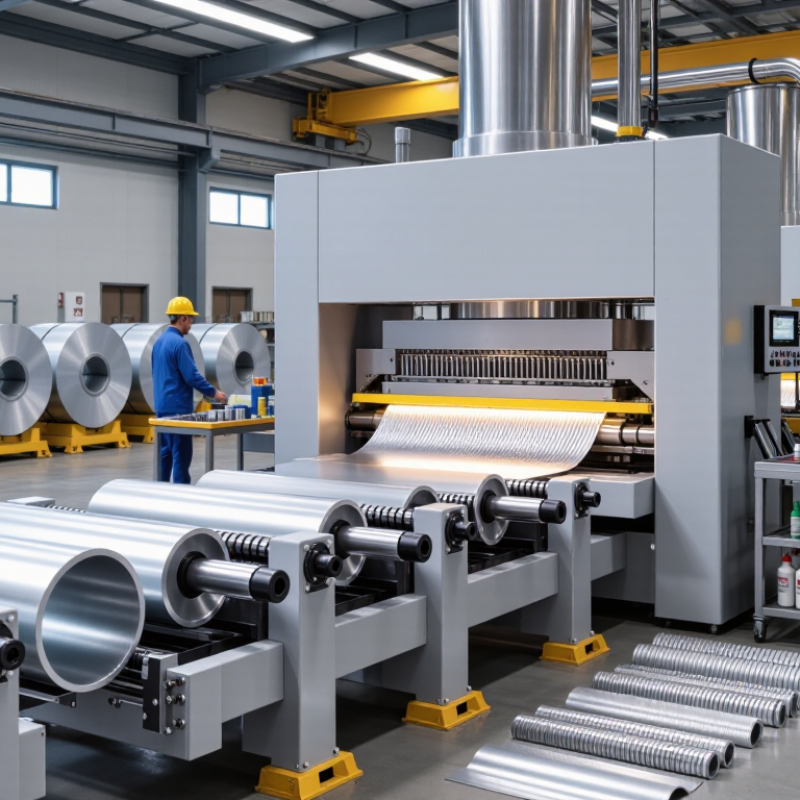
Choosing the right Aluminum Fin Press Machine begins with the fin, not the machine catalog. Each project has different aluminum grades, strip thicknesses, fin heights, pitches, and production targets. A press that forms thin fins beautifully may struggle with thicker material. Another may produce excellent samples but waste too much scrap during continuous production. These details matter on the factory floor.

Heat-transfer authority Dr. Frank P. Incropera wrote, “Heat transfer is the science that seeks to predict the energy transfer between material bodies.” His statement explains why machine selection cannot rely only on press tonnage. Fin geometry affects airflow, surface area, pressure drop, and final exchanger performance. The machine must also control feeding accuracy, forming stability, tooling alignment, and repeatability. Small dimensional errors can become visible across thousands of fins.

Look beyond speed claims. Ask for trial forming with your actual aluminum strip. Check burrs, wrinkles, springback, noise, and setup time. Review servo control, die replacement, lubrication, safety protection, and after-sales support. A reliable supplier should explain maintenance intervals and provide measurable test results. Do not accept vague promises.

Mistakes still happen.

A high-speed Aluminum Fin Press Machine may be the wrong choice for short runs or frequent tooling changes. A lower-speed model might deliver better practical output after setup losses. Energy use, operator training, spare parts, and floor space deserve equal attention. The best decision is rarely the most impressive specification. It is the machine that consistently produces your required fin quality, at a realistic cost, under real working conditions.
How to Choose the Right Aluminum Fin Press Machine

Define Your Aluminum Fin Production Requirements

Before selecting an aluminum fin press machine, define the product clearly. Record fin height, pitch, length, thickness, alloy, and required tolerance. A fin made from 0.08 mm aluminum behaves differently from one made from 0.20 mm stock. Coil width matters too. It affects material utilization, die layout, and feeding stability. The International Aluminium Institute reported global primary aluminum production of approximately 70.5 million tonnes in 2023. That scale does not guarantee suitable material availability for every alloy or thickness. Confirm coil temper, surface condition, and incoming dimensional variation with suppliers.

Production targets should be measurable. State fins per minute, annual output, operating shifts, changeover time, and acceptable scrap. A practical trial should measure feed accuracy after several thousand strokes, not only during a short demonstration. Press capacity must match the forming load, but capacity alone is not enough. Check stroke length, shut height, feeder synchronization, die space, and vibration behavior. The International Aluminium Institute notes that recycled aluminum can require about 95% less energy than primary aluminum, according to its industry sustainability data. Recycled input may reduce impact, but inconsistent chemistry or surface quality can increase rejects. That trade-off needs testing.

Keep the requirements imperfectly honest. Forecasts often exaggerate output. Measure real demand. If the line must produce 500,000 fins monthly, calculate uptime, maintenance, and scrap instead of dividing by calendar hours. Include a 5–10% process margin only after trial data supports it. The U.S. Department of Energy’s industrial efficiency reports repeatedly identify idle time and compressed-air losses as practical energy concerns. Therefore, record energy use, setup time, and rejected parts during validation, not after installation.

Compare Machine Types, Capacity, and Forming Methods

How to Choose the Right Aluminum Fin Press Machine

Choosing an aluminum fin press machine starts with the fin design, not the machine brochure. Measure material thickness, strip width, pitch, and required output. A small progressive press suits thin fins and stable, high-volume production. A servo-driven press offers better control when pitch changes frequently. Hydraulic equipment can handle demanding forming force, but its cycle speed may be lower.

Capacity needs careful calculation. Check rated tonnage at the actual stroke position, not only the maximum figure. Compare bed size, feed length, coil weight, and usable stroke. Leave working space around the die and feeder. Too little capacity causes overloads, uneven fins, and premature die wear. Excess capacity can increase energy use and purchase cost. Bigger is not automatically better.

Forming method changes the final fin shape. Louvered fins need precise cutting and forming control. Plain plate fins may require simpler tooling and faster feeding. Plate-fin assemblies often depend on consistent height, flatness, and edge quality. Ask for sample trials using your aluminum grade and thickness. Inspect burrs, springback, pitch accuracy, and operating noise. Real shop conditions matter. I have seen a machine pass a demonstration test yet struggle with coil variation. That risk is easy to underestimate. Confirm maintenance access, sensor protection, operator training, and replacement tooling before approval.

How to Choose the Right Aluminum Fin Press Machine - Compare Machine Types, Capacity, and Forming Methods
Machine Type Typical Forming Method Suitable Fin Materials Typical Material Thickness Typical Production Capacity Strengths Limitations Best Application
Mechanical Power Press Progressive, compound, or single-operation stamping with a die Aluminum strip and sheet, including common heat-exchanger alloys Approximately 0.10–0.50 mm, depending on alloy, fin geometry, and die design About 60–600 strokes per minute; output depends on pitch and parts per stroke High production speed, repeatable stroke motion, and relatively low operating cost for large batches Less flexible for frequent tooling changes; available forming force reduces near the bottom of the stroke
Servo Mechanical Press Programmable stamping with controlled slide motion Thin aluminum strip and sheet used for detailed fin profiles Approximately 0.08–0.50 mm, subject to tooling and material condition About 100–600 strokes per minute, with speed selected according to forming requirements Adjustable slide speed, dwell, and motion profile; supports better control of difficult forming operations Higher purchase cost and greater control-system complexity than a conventional mechanical press
Hydraulic Press Die forming, embossing, coining, or deep forming under controlled pressure Aluminum sheet and thicker or less easily formed stock Approximately 0.30–2.00 mm or more, depending on press force and tooling Typically about 5–60 cycles per minute Full forming force is available throughout the stroke; pressure and dwell can be adjusted Lower cycle speed, higher energy use in some configurations, and generally less suitable for very high-volume fin stamping Low-to-medium volume work, thicker parts, prototypes, and forming operations requiring controlled pressure
Roll Forming Line Continuous profiling through sequential forming rolls Aluminum coil and strip for continuous corrugated or shaped profiles Approximately 0.20–1.50 mm, depending on profile and roll tooling Commonly about 10–60 m/min line speed; actual output depends on cut length and profile Continuous production, efficient material flow, and consistent long-profile geometry Less suitable for discrete louver patterns; profile changes require roll-set adjustments or replacement Long continuous fin profiles, panels, and high-volume products with a constant cross-section
CNC Turret or Servo Punch Press Programmable punching, piercing, and localized forming with indexed tooling Aluminum sheet and cut blanks Approximately 0.50–3.00 mm, depending on machine capacity and tool clearance Typically about 200–1,000 hits per minute; finished-part output depends on hit count and nesting Fast changeover, flexible programming, and economical production of varied flat patterns Usually slower and less economical than a dedicated progressive die for extremely high-volume thin-fin production Prototype work, short runs, custom heat-exchanger components, and frequent design changes
Progressive Die Stamping System Multiple operations performed in sequence while coil stock advances through one die Thin aluminum coil suitable for stamping and controlled feeding Approximately 0.08–0.50 mm, depending on fin shape and alloy temper About 100–800 strokes per minute; one or more components may be produced per stroke Combines piercing, louvering, forming, and cutoff in one automated sequence High tooling cost, longer setup time, and limited economic benefit for small quantities
Manual or Pneumatic Bench Press Single-stage punching, bending, or forming with simple tooling Aluminum sheet, strip, and pre-cut blanks Approximately 0.20–1.00 mm, depending on force and tooling Typically about 10–60 cycles per minute Low initial investment, simple operation, and convenient for samples or repair work Lower productivity and consistency; not normally intended for continuous large-scale fin production Samples, maintenance parts, training, and small-batch production
Selection guideline: Choose the machine according to fin geometry, aluminum thickness and temper, required force, strip width, stroke rate, coil-feeding method, tooling cost, production volume, and acceptable dimensional tolerance. The capacity figures above are general industry ranges; the final specification should be verified through material trials and die-load calculations.

Evaluate Material Compatibility and Product Precision

How to Choose the Right Aluminum Fin Press Machine

Evaluate Material Compatibility and Product Precision

Choosing an aluminum fin press machine starts with the material, not the machine price. Different alloys respond differently during forming. Common fin stock may include 1100 or 3003 aluminum, with various tempers and thicknesses. Check the machine’s working range against your actual coil specifications. A press designed for thin, soft stock may struggle with harder material. Excessive force can create cracks, wrinkles, or uneven louver edges. Small details matter.

Experienced operators also inspect coil width, feed stability, and surface condition. Oil residue can affect feeding accuracy. Uneven tension may shift the strip during high-speed production. Ask for a trial using your own aluminum stock. A short test often reveals problems that brochures hide. Measure fin pitch, height, thickness, and flatness after pressing. Use calibrated micrometers and suitable visual inspection tools. Do not rely only on the control panel readings.

Precision depends on more than the press itself. Die alignment, guide design, feed control, and maintenance all influence the finished fin. During one production evaluation, a minor guide adjustment reduced edge variation noticeably. Yet perfect results were not immediate. Some settings required repeated testing, and that should be expected. Review sample consistency across several batches, not one impressive piece. Record burr formation, dimensional drift, and reject rates. A reliable machine should produce stable results without constant operator correction.

How to Choose the Right Aluminum Fin Press Machine

Compare representative room-temperature properties of common aluminum fin materials before selecting press capacity, tooling clearance, and motion-control precision. Higher yield strength generally requires greater forming force, while higher elongation usually provides a wider forming window. Actual values vary with alloy temper and sheet thickness.

Reference values: 1100-O, 3003-O, 5052-O, and 6061-O aluminum sheet. Use the required fin pitch and height tolerance to verify press repeatability, die alignment, and feed accuracy in addition to material compatibility.

Check Automation, Safety, Maintenance, and Energy Efficiency

How to Choose the Right Aluminum Fin Press Machine

Automation should improve control, not simply increase speed. The International Federation of Robotics reported 541,302 new industrial robots installed worldwide in 2023. This figure shows the industry’s direction, but a fin press still needs practical automation. Check servo-feed accuracy, automatic strip alignment, die sensors, and clear PLC diagnostics. A fast machine with poor setup control can create scrap within minutes.

Safety deserves equal attention. Look for fixed guarding, interlocked doors, emergency stops, and simple lockout points. Ask whether operators can inspect the die without reaching into hazardous areas. ISO 12100 provides a recognized framework for machinery risk assessment. Require documented testing, not verbal assurances. Small errors matter.

Maintenance access affects real production costs. Choose a press with visible lubrication points, replaceable wear parts, vibration monitoring, and easy access to the feeder. Record downtime, spare-part use, and mean time between failures. Energy efficiency also needs measurement. The IEA’s Energy Efficiency 2023 report estimated global efficiency improvement at only 2.2% in 2022, below the 4% annual improvement target.

2.2% 4% annual improvement target

Compare kilowatt-hours per 1,000 fins, including standby consumption and compressed-air demand. Start with the press. Then test it using your actual aluminum thickness, fin geometry, and production rhythm. A perfect machine rarely exists; an overlooked maintenance task can still defeat excellent specifications.

Calculate Total Cost and Select the Best-Fit Machine

How to Choose the Right Aluminum Fin Press Machine

Calculate Total Cost and Select the Best-Fit Machine

A low purchase price does not guarantee a low production cost. I have seen buyers overlook tooling, installation, and operator training. These expenses can change the decision quickly. Build a five-year cost model before requesting final quotations. Include machine price, freight, setup, power use, labor, tooling, maintenance, and spare parts. Add the cost of planned downtime. Keep a separate allowance for unexpected repairs. Your estimate will never be perfect.

Measure your actual fin material carefully. Record strip width, thickness, pitch, coil weight, and required output. Match these figures with press force, stroke rate, feed accuracy, and working width. A machine with excessive capacity may waste energy and floor space. A smaller unit may create unstable feeding or excessive scrap. Ask for sample production using your aluminum specifications. Inspect fin height, collar quality, burrs, and dimensional consistency. Small defects become expensive at high volume.

Calculate cost per acceptable part, not cost per stroke. Include setup time and material lost during changeovers. Review the control system, guarding, noise level, and maintenance access. Ask how quickly technicians can respond and how easily critical parts can be sourced. Speak with current users if possible. Their experience often reveals recurring problems omitted from sales documents. I once treated promised output as guaranteed and ignored a long changeover period. That assumption weakened the entire calculation. Choose the machine that fits your real workload, service capability, and future limits.